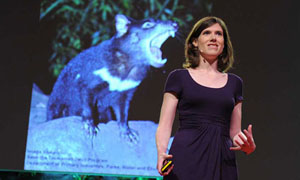
I was privileged to meet award winning scientist Elizabeth Murchison earlier this year when she explained to me her research which is dedicated to saving a fierce looking Marsupial creature known as the Tasmanian devil from possible extinction in the next 20 -30 years due to a transmissible facial cancer it passes on through biting other devils.
Her inspiring story is featured in the latest Times Eureka science supplement and, like me, their writer wonders if there are transmissble cancers in humans too. The thought of a contagious cancer being passed from human to human this way is very scary.
Alarmingly, it seems that a transmissible cancer could be possible. Elizabeth told me of an American doctor in the 1950s, Chester Southam, who discovered that this was possible after deliberately injecting humans with cancer during a trial; while most did not develop cancer, a few who  had a suppressed immune system did catch the disease.
Dogs can also be affected by a canine transmissible veneral tumour; this cancer is believed to be tens of thousands of years old. It is now known from genetic archaeology that the first dog to be affected was some kind of wolf that lived alongside Neanderthals.
Elizabeth, who comes from Tasmania, spoke about her research at a Ted X conference which was beamed around the globe, and you can view her awesome presentation from the video here. Here she describes her work:
“I collected samples from the tumour of a devil called Jonas and other parts of the body. When I looked at the sequence of DNA and compared tumours, I found that they had different genetic profiles, they didn’t match cells from his own body.
“Our research suggested that the cancer cells first arose in the body of another devil. I also talked about transmissible cancer among dogs, mainly stray dogs, which is spread by mating. This contagious cancer is also much closer to us here in the UK as I have been contacted a couple of times in the last few months by vets in the UK who have seen it in dogs imported from Greece and Romania.â€
“There was a lot of sympathy for the devil and, despite its fierce appearance, they can be very adorable too, especially as babies if they lose their mothers and are adopted by humans. Everyone asks if I have cuddled one, but the truth is I haven’t. I have mainly only seen sick and dead devils.”
It’s hard not to have sympathy for this devil, and I wish Elizabeth every success. Could her findings one day be critical for humans too as earning how cancers adapt from one devil to another could help us understand how human cancers adapt to colonise new sites in the body.
Interesting and fascinating.