If a robot can miraculously make genetic discoveries which have been unsolvable to scientists for decades, how many diseases will these incredible devices go on to cure?
A robot called Adam was devised by scientists at Aberystwyth University and Cambridge has become the first of its kind to identify a gene which controls an enzyme crucial to the production of lysine, an amino acid essential to growth.
This discovery could potentially help find a cure for malaria, the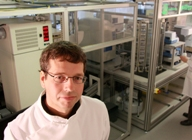 world’s biggest killer of communicable diseases.
Robots are proving increasingly valuable because they can carry out large numbers of repetitive tests that are incredibly boring for a person and lead to a loss of concentration.
Because biological organisms are so complex it is important that the details of biological experiments are recorded in great detail. This is difficult for human scientists, but easy for robot scientists. The plan is now to have teams of human and robot scientists working together in laboratories.
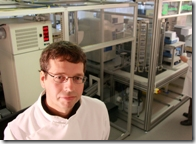
Prof Ross King (pic, with Adam in the background), who is leading on this, explains why this is so crucial: “If science was more efficient it would be better placed to help solve society’s problems. One way to make science more efficient is through automation. Automation was the driving force behind much of the 19th and 20th century progress, and this is likely to continue.â€
I imagine a robot is only as good as the scientist who is controlling it. But the potential here is huge, especially as Adam is soon to be joined in the lab by a robatic companion called Eve. As well as being used to help find cures for deadly diseases and other medical ailments, I wonder if the use of robot scientists means there is no longer a need to use animals for scientific research. And can they work alongside plant scientists as well to help develop new crops to feed the worlds’ future generations in areas of drought?
Congratulations to the Biotechnology and Biological Sciences Research Council (BBSRC) and the Higher Education Funding Council for Wales for funding this.
Interesting post Ellee. I sometimes wonder if it might be better to put robots in charge of the banking system 🙂
[…] Ellee Seymour added an interesting post on Can robots help save the world?Here’s a small excerptIf a robot can miraculously make genetic discoveries which have been unsolvable to scientists for decades, how many diseases will these incredible devices go on to cure? A robot called Adam was devised by scientists at Aberystwyth University  and Cambridge has become the first of its kind to identify a gene which controls an enzyme crucial to the production of lysine, an amino acid essential to growth. This discovery could potentially help find a cure for malaria , the world’s bigge […]
[…] in to grab a fantastic education or to see a once-great football team: Ann Arbor kind of blows Can robots help save the world? – elleeseymour.com 04/03/2009 If a robot can miraculously make genetic discoveries which have been […]
I’m sure they can, but I wouldn’t want a robot to operate on me, like they do in “Holby City”. On the other hand, I want one of those robotic vacuum cleaners-1
It would be good if they could test drugs on robots rather than animals
I seriously doubt that the robot can “find a cure for malaria.” Very unlikely. I do however find that the science behind robots is increasing daily and I have seen some phenomenal stuff being made. But there are limits. Remember that…