 I cannot understand how anyone could give away an
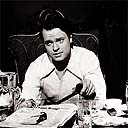 Oscar, which is what Orson Welles did as payment to a Los Angeles cinematographer.
Was he really so hard up after making the powerful film Citizen Kane, which caused a terrific storm in 1941 when there were attempts to suppress it:
Nearly every film maker was in some way influenced by this movie. This movie also had a great impact in its time. The title character was based on media giant William Randolph Hearst. He was that generations Donald Trump. He opposed this film so much he did everything in its power to stop its release and almost succeeded. Lastly this film contains some of the strongest and most common themes in literature; Life versus death. It is for these reasons why this film is so revered.
In fact, the Oscar was awarded jointly to Welles and Herman J Mankiewicz for best original screenplay in 1942 – the only gong the film won, despite nine nominations.
The award was believed to have been lost until it surfaced at a Sotheby’s auction in 1994. Beatrice Welles, Orson’s youngest daughter, sued Sotheby’s and the cinematographer and eventually received the Oscar. When she tried to sell it herself, the Academy of Motion Picture Arts and Sciences sued her as part of its policy to keep Oscars off commercial markets.
Since 1950, the academy has required Oscar-winners to give it the first right of refusal to buy back an Oscar for $1 (50p). Because this particular Oscar had been awarded before 1950, among other reasons, Welles was able to win the court case. In 2003, Welles sold the Oscar to a Los-Angeles charity called the Dax Foundation, which is now auctioning the Oscar. It is estimated to fetch between $800,000 (£393,000) and $1.2m (£590,000) when it goes under the hammer in December.
A unique Christmas present for the man or woman who has everything – except an Oscar.
Ellee: What a fantastic post! I suggest “Orson Welles: A Biography” by Ann Sperber. This film broke so much technological ground from the way it told the story out of sequence, to camera angles and so much more. Orson was a remarkable person to see as a guest on a talk show. Two hours after taping “The Merv Griffin Show” he died. But what a genius!
I can’t understand anyone, no matter how wealthy, spending their time and wealth trying to stop the release of a movie – no matter how innacurate the portrayal.
After all if they made a film of Diana getting murdered by british intelligence, because she is preganant by Dodi (a decadent Muslim) – would Prince Charles give a hoot – even if they portrayed him as having ordered the hit.
After all that is what Bond and “A licence to kill” is all about – and movies, are about maje believe.
But hey who needs to worry about the State and big brother anyway. Phone up Panther Taxis and they know your number and where you are calling from. Anyone who can get access to your CRB check can know everything about you. Anyone in India can get access to your bank account, and knows your tastes and where you shop. And lets face it anyone who can get access to your medical records can either refute or invalid your insurance, if you did not declare something on the application form.
But hey, life is good. Just make sure that like a good little boy or girl, you get up in the morning and go to work, if you want to be able at the end of the month your bills to pay.
Sure we are all free to choose, to choose from the range of choices offered us, or from those things we can afford to pay for. As for democracy – you are free to vote with your feet, where you shop, what you eat and who you get your energy from.
But are you free to choose which university to go to, or free not to pay tuition fees? Hmmm, it seems ‘democracy’ introduced tuition fees, and medical fees, and ‘private’ dentistry. Mind you no one said that just because you pay for it, it was necessarily going to be any better than when it was free – it simply means that you can be discriminated against if you cannot pay – and Universities, Foundation Hospitals and Private Dentists, can choose who they ‘educate’ who they treat, and whose teeth they save (or fix). This usually means by default they choose those who can pay most.
Money doesn;t make the world go round, it is money that goes round and round, and people spend their time dreaming up new schemes how to make (earn) even more for less and less.
I second Michael Manning. Welles was clearly doing what Marlon Brando also did – show his disdain for the institution. Still, it seems a strange thing to do.
This Oscar has had a very varied career. Good story Ellee.
I’ll order half a dozen right now! People with more money than sense will buy anything, won’t they – when there is so much need in the world.
It will cost a lot to get that Oscar. More than estimated, I think.
Makes Spielberg’s purchase of the sled from the film for $50K seem like a bargain.
There’s a good TV movie dramatisation called RKO281* which tells the tale. A cut above most TV movies.
It is amazing to think that he was only 26 when he made it. Very few directors had such an amazing debut.
I think it is disgraceful that the daughter sold her father’s Oscar, it’s such a unique family heirloom and she went to so much trouble to acquire it. Was it really just for financial gain?