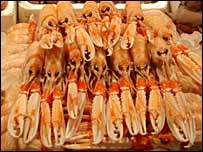
 Many of us will be tucking into our prawn cocktails over the festive season, but how would you feel if you knew those prawns had travelled 12,000 miles before ending up on your plate?
Ethical eating is going to be big business as carbon footprinting takes off, more companies like Young’s could find themselves named and shamed for shipping prawns off to Thailand from their UK base simply to be hand peeled because of their cheaper labour.
This decision resulted in the loss of 120 UK jobs, and environmentally conscious customers are now threatening to boycott Young’s.
Young’s has published a statement outlining their reasons, that prawns intended for hand-peeling are always matured for three weeks and that the greenhouse gas emission involved in shipping the prawns to Thailand would be roughly comparable with storing the product in freezers in the United Kingdom.
But is it falling on deaf ears, are we becoming too blinkered to see their point of view, do we just hear what we want to hear on occasions like this? The fact that heavy local job losses are involved has made this a difficult case for Young’s to argue in their favour.
At the same time, Young’s has to run a profitable business, so are we prepared to pay more for our prawns to be peeled in the UK? Up to a point, I think, it’s a case of finding the right level that would please both the consumer and business. And how do you feel about your food travelling all those miles, leaving the UK and travelling half way around the world and back again?
With 5.5m economically inactive people in the UK, you should be asking why labour rates aren’t lower in the UK for unskilled labour?
Is this an example of the environmental impact of the national minimum wage!?!
Elle, I don’t think we should have a price increase as a result of British workers working for youngs. They could just simply reduce their greed on profits. Not rocket science is it?
I do take ethical eating seriously, yes, but not to the point where it becomes an obsession. Here in Sicily hardly anything is imported food-wise. That means you can’t get some items, but it also means you eat what is in season. I agree with you that a compromise solution has to be found. Many people do not have the luxury of being able to pay more for “ethical” food, though.
It does seem absurd from an environmental point of view to buy green beans in the supermarket that have been flown, or shipped, from Africa. Exotic fruits similarly. It is possible to hunt out local produce but it takes time and money. However, yes, where possible, ethical eating is to be encouraged, but the people who want to do it will just have to pay more. It’s a choice, like most other things in life.
Ellee good post you are right this could become an increasing preoccupation in the public mind. Especially with regard to eating fruit and vegetables in season and supporting British producers.
That sort of food is way too risky health-wise
Hi Ellee,
I once had the funky pleasure of a visit to Grimsby’s fish dock, Ross House and the Ross Young’s factory in the early 90s. I was quite surprised that instead of using the local catch, the factory was using imported frozen, white fish from South America to make fish fingers, fish cakes etc. Part of the reason cited was the depletion in North Sea fish stocks, the EU etc, but it just boiled down to simple economics in the end.
It’s obviously right, now, to challenge the concept of ‘simple economics’. How you do that yet promote free trade is the real challenge. The government has a duty as arbiter here and we have to think about strategic investment in local farming, fishing etc rather than regulation as the long term answer.
Northwing, Hi, your comment is very perceptive, it is also interesting to learn of your observations of Young’s factory in Grimsby. You can imagine how chicken from China is used in our chicken nuggets, the beef from Brazil in our burgers, the list is endless, but how much longer these practices will continue remains to be seen. It raises all those interesting issues that you have mentioned.
I had an interesting discussion about food miles with the 1st year PR students at Bournemouth University the other week – and they raised the dilemma of supporting workers in poorer countries through FairTrade compared to the issue of how far your food has travelled. That’s the problem with ethical issues – it takes more than the superficial thinking we often see in the headlines.
You won’t be surprised that my support is fully behind a free market. Young’s could have made a big thing of sticking by their workforce, and got some good publicity from the gesture, only to go bust along with the many other businesses in this part of the world who have disappeared recently as less loyal employers undercut them on price.
The alternative, a business environment micro managed by useless meddling politicians, doesn’t bare thinking about. We all know where that leads.
The answer to this conundrum is difficult, which is why the politicians usually duck the issue, but we need more infrastructure, more investment, and a more favourable business regime in the north. And that’s just a start.
John, This is a real moral maze, it raises so many interesting points. And it is going to be tough for businesses to work around these ethical issues and retain a positive profile if the public mood – as well as Government – swings towards carbon footprinting and reducing emissions.
Do we need to eat prawns in the first place?
People want all sorts of ethical things – until they find themselves having to pay for it. I dont blame the company for not giving in to people who get all indignant at the 12 thousand-mile journey – but then will buy competitors’ products if they’re cheaper.
The public does not seem to always realise that their ethics have to be met through their wallets.
On Thursday, I was with a few other business volunteers at a school in the London Borough of Barnet. The session involved around 100 pupils and the morning was spent teaching them presentation skills. Not at all easy but god fun and rearding.
The content was “Fairtrade” and some of the issues raised above were mentioned. 14 year olds nowadays are pretty clued up!
What an interesting subject for school kids to debate, especially as the fair trade issue is turning full circle now.
Why are you talking about prawns when the picture and the story is about langoustines? As a I don’t believe that humans are having a significant effect on the climate, especially with respect to emissions of a minor greenhouse gas, I don’t see the distance as an ethical issue. I do think that it is a good thing for developed countries to export low skilled jobs to countries that don’t currently have the wherewithall to have a large-scale skilled economy. With the opportunities afforded to people in the developed world one should really not have to peel langoustines for a living. Are we part of a global community or a narrow national one?
What have you got against Thais? Youngs’ employees in the UK are no more or less deserving of a job than people in Thailand. And we’re all consumers several times over whereas we are generally only a producer once. Let the market do its job and in the long run everyone will be happier and better off. I couldn’t agree more with DocBud about exporting the sort of filthy, zero-skill jobs that the working class used to do. Arguing otherwise is to support autarky, and that’s foolish.
DocBud, The BBC have described them as prawns (see quote), though I believe langoustines have been mentioned too, I think people get the picture, whichever one you say:
“Environmentalists have condemned plans by a seafood company to send prawns on a 12,000 mile round trip to Thailand to take advantage of low-cost labour to process the shellfish.”
I guess we could also question the air miles travelled for Australian and Californian wines and New Zealand wines. This is an interesting ethical debate that I think will hit the headlines many times now. I personally think that Young’s have made a fair case in this instance, measuring the transport carbon emissions against those used at home in refrigeration. At the end of the way, cheaper labour in Thailand was the deciding factor.
Ethical eating seems more like miserable eating, I live in Elephant & Castle, so, as far as I know only produces bread and cakes. So, every other food I have buy here would have had to be imported from somewhere else.
There appears to be a logic, and an assumption in ethical eating that, food that has come thousands of miles is morally bad, and that food produced locally is morally good. Do we really want to live in a society that is obsessed with the ‘carbon footprint’ of their food before they eat it?
Are we being morally blackmailed to stop eating banana’s and grapes, or parma ham and cheese, or how about cutting out coffee and tea? All because of the size of it’s carbon footprint? Should we really be judging every single little thing by such a standard?
Ethical eating on the Walworth Road road, in south London would mean rapidly losing weight, or risk being labelled a ‘carbon footprint’ hypocrite.
It’s not just prawns that go to Thailand for their holidays. Next time you’re booking that cheap, ozone-eating flight, think again – save the planet and try Ramsgate instead!
Just an hour and a half on the train and you’ve got golden sands, a beautiful harbour, delightful cafes, and a decent cup of tea to boot. What more could you want?
Blimey, I sound like the Ramsgate tourist board now.
Eastcliff Richard, Nice idea, very ethical too, but I cannot help wondering if Ramsgate holds quite the same attractions as Thailand does for many of its tourists! It will have to work pretty hard at promoting itself if it wants to compete with their very distinctive charms and culture.
Isn’t it strange that it is no longer “ethical” to provide work for people in the third world.
Just how far food travels is important. I think 50 years ago the average vegetable travelled about 200 klm to market. That figure is now over 2000klm.
The average cost in sustaining our life-style in terms of acres has tripled per person ( Jim might have a better idea on the exact statisitics)…
So it is simple.. the carbon cost for each one of us in the west is frankly outrageous and unsustainable.
Think about just how many litres of fossil fuel went into catching, shipping, peeling and returning your prawn.
Yes, Simon, it is easy to overlook the true costs (in energy terms) of producing our food. Westerners spend roughly 70 calories of fossil fuel to produce one calory of food: a situation that can be sustained only so long as oil is cheap and plentiful.
I recently saw nicely packedged cartons of mange tout in a local supermarket that had been imported from Kenya. When I was a kid we actually ate the peas (rather than the shells) and my dad grew them in the garden!
Geoff,
you gave me good laugh yesterday…You said do we need to eat prawns?? Then you give them to me for dinner…. so the answer must be yes you do need to eat prwns….:-)
We’ve got a very highly regarded Thai restaurant – how about that? And some of the locals are pretty, er, exotic!
“Scampi tails are always matured in freezer storage for three weeks before peeling.”
Believe that and you can believe in anything.
Even better, eat that and you can eat anything.
Where I come from (Trieste, Italy) we eat a lot of scampi, they’re fresh and you peel what you eat. And they’re tasty.
It’s the natural alternative to eat 3 weeks old scampi. I now live in London and try not to eat fish that travelled the world after death.
I’m not perfect, occasionally gluttony makes me fall into temptation.
But 3 weeks old fish is no risk for that.