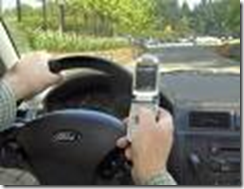
I was really surprised when I read the findings of a Facebook study conducted by the RAC Foundation on how almost half of Britain’s morotists txt + drv at the same time.
I’ve written the results in a press release for them which is published today and realise that I must be included in that figure, that I leave my mobile switched on when driving and will check any messages that ping through if I am waiting at traffic lights or a junction.
I now know better and shall not do it any more, but how many other drivers fall foul of this law too and do not realise it is an offence?
It’s also interesting to see how major organisations are using Facebook to conduct surveys. It is one of the hot topics up for discussion at this year’s Social Media Influence conference which I shall attend on 4 June. Formerly known as Blogging4Businees, it’s a must for anyone who needs to understand how social media can work with – or against – businesses today, how online conversations are ignored at their peril.
Here is the press release, do you text + drv too?
Almost half of Britain’s motorists regularly flout the law by texting and driving, putting themselves and other road users at risk, according to figures published today by the RAC Foundation.
A survey of 2,000 Facebook users revealed alarmingly that 45% of UK drivers text whilst driving, with only 11% of motorists turning off their phone or switching it on mute – leaving 89% of drivers open to the distractions caused by mobile phones. Research has found that if you use a mobile phone whilst driving, you are four times more likely to have a crash.
This survey marks the year’s anniversary of the change in law which penalises motorists with a £60 fine and 3 penalty points for using their mobile phone whilst driving, which includes texting and driving. It discovered that the young and techno savvy were more likely to text and drive in congested parts of the country, and that texting whilst driving differs throughout the UK. It is highest in London (53%), and Manchester (50%), and lowest in Aberdeen (31%), Edinburgh (36%), Bristol (36%) and Glasgow (38%).
The RAC Foundation plans to continue its innovative research into texting drivers following its survey, which highlighted that five distinct groups of texting drivers can be found on UK roads. They are:
- Manic multi-tasking multimedia maniacs: 21% of this group found read and send texts in free flowing traffic. It is dominated by techno savvy men aged 18-24 who regard the phone as a personal extension, with texting an almost automatic reaction. The highest proportion of this group can be found in Manchester (26%), followed by London, Wales and Leeds (both 25% ?).
- Opportunistic time optimisers: 19% of those surveyed read and/or send text messages when they are stuck in a jam. This delay may cause people to text, for instance to let others know they are going to be late. Women are more likely than men to fit within this group and this activity decreases with age. This texting approach was by far most common in London (24%).
- Anti-action aware texters: This is the largest single group accounting for 44% of all those surveyed. This group will not text whilst driving, but will leave their phone audible. This may distract the driver or encourage them to alter their driving plan (i.e. stop to read the text) which could create road safety problems, especially if they stop to view a text at an inappropriate location. Women are most likely to be text aware, and this increases with age. Drivers in Glasgow (51%), the West Midlands (51%) and Bristol (51%) are most likely to fit within this category.
- Casual communication perusers: This group accounts for a mere 5% of those surveyed. These drivers read their texts in moving traffic, but would not consider responding or sending messages whilst driving. This activity is most common in Manchester (7%), Glasgow (7%) and Newcastle (6%).
- Virtuous vigilantes: 11% of those surveyed make up this final group of motorists. They responsibly switch off their phones or put them on mute to avoid distractions. Women are marginally more likely than men to fall into this category. Motorists in Aberdeen (19%), Edinburgh (16%) are particularly conscientious about these safety measures.
Elizabeth Dainton, Research Development Manager of the RAC Foundation, said the survey clearly demonstrated that a large proportion of UK drivers were breaking the law by texting and driving.
She said:
“Many young people may not be aware that it is illegal to text and drive and how it places them and other road users in potential danger. Urgent action is needed to address this increasing problem, especially as the ‘Y’ generation, who have grown up with technology and computers, begin to take to the road.
“It is really hard to do two things at once. The fact that using a mobile phone whilst driving means you are four times more likely to have a crash clearly shows how unwise it is. And if you have an accident whilst texting and driving, you can be prosecuted for not using due care and attention on the road.
“Our message is clear – do not text and drive. I strongly urge motorists to switch off their mobile phones when driving or put them on mute. Messages can easily be picked up once the journey has finished and it removes temptation to send or read messages. It also removes the mental distraction that can be caused by receiving a voicemail message.”
Update: We’ve had some excellent coverage from this, including coverage by the Daily Mail, ITN, the Press Association, Channel 4 News, BBC, Glasgow Herald and motoring and cellular mags.
Ellee: What a timely piece for me to read, as I test drove a Mini Cooper over a week after taking a Defensive Driving Class to erase a (alleged) speeding ticket from my record. Here in Phoenix, we lead the nation in intersection collisions from people applying makeup, men using portable electric razors, speaking on cells phones and more. We have become obsessed with multi-tasking and yet, I have come to question if we really are more productive? I suggest we are counter-productive! Good topic! 🙂
Excellent post, Ellee. Excellent. What amazes me is people’s preference for texting. I personally prefer it in number two spot behid personal communication and a long last – the telephone.
I struggle to text when I’m sitting in an ordinary chair with my glasses on; I certainly couldn’t text while driving! When my phone beeps it just puzzles me! ‘What’s that noise?!’
As someone who is about to take his driving test in 3 days, I will remember not to txt and drv!
John, good look, and I would certainly advise you not to txt + drv.
I know a chap who was imprisoned for driving at 90mph in the fast lane with a map over his steering wheel and talking on his mobile phone. Nobody was affected by his actions.
Texting and driving is one of the most dangerous aspects of driving on the roads these days. I hope the message gets out before people die!
I think more people should be jailed for idiotic behaviour whilst driving – it’s not clever and it’s not forgiveable; perhaps there should be a new offence of attempted manslaughter…
IC, in a case like this, you would have to prove intent, so a motorist is more likely to be charged with careless or dangerous driving. The law needs a review on careless driving as so many people are killed on the roads by bad drivers, yet the motorist is charged with careless driving instead of death by dangerous driving.
Don’t drive, Ellee! Do txt, but switch off phone in class – I wish students would do the same!
I applaud the UK legislators for banning hand held phones. That is step one in saving lives, but Let’s face it, connectivity gives us competitive edge. If we turn off our cell phones, we will be at a disadvantage by the next person who is still using it. The legislative bodies have done their job, but the Auto Telcom and Insurance companies have shirked their responsibilities because their busines model does not allow them such flexibility. Thw result is that existing automotive and telecom business models continue to clash on the road and Insurance business model saty profitable by passing the cost of the added risk to the general population.
I agree that cell phone use while driving is an epidemic sweeping the globe. For each car on the road, (roughly 650 Millions world wide), there’s at least 4 Cell phones and the possibility of a driver having a cell phone is 4 to 1.
What is need is not more legislation, enforcement or Diconnectyivity. What we need is managed middle ground that’s based on safety.
This is where innovative thinking can come in to solve the problem by re-engineering our life behind the wheel while including teenagers as well as elderly into the solution.
This Re-engineering should create order in the vehicle and give priority to driving tasks over other activities, but still enable other activities while helping keep/or even assuring Eyes on the Road and Hands on the Wheel.
We have developed, proved and globally patented a system that balances the entire driving experience with emphasis on safety, but still allowing drivers to use communication technologies while driving. Our system has the following key features:
1- Hands are monitored to be on the steering wheel, this enables configuration to enable or disable devices when hands status is not compliant with safety.
2- The driver controls all accessories, including cell phones from “thumb gesture� on the steering wheel. (Yes, texting is possible if the laws allow it)
3- Incoming communications are silenced when Drivers are passing, merging, changing lanes, turn signal engaged, etc.(So as not to surprise the driver).
4- Any information, wether from a caller ID or navigation direction is given verbally to the driver so there’s no need to look at a screen
5- System is calibrated to driver’s skills and experience so a teen aged driver is given certain allowances and elderly drivers are provided more assistant.
6- System is Geographically aware based on Navigation data of curves, lights, stop signs and other legal boundries and can warn driverns to slow down or modify behavior when distracted
7- The system can fits into a cell phone, and connects to the car network “CAN� physically or wirelessly and communicates with the steering thumb sensor in the same manner.
8- The system also detects signs of DUI from the driver handling the steering wheel, heart, sweat, temp, gripping strength and steering corrections, and then reports the driver to police, activate the emergency lights and limit speed of the vehicle.
We need to stay connected to stay competitive, but we need to do it safety. What we need is to educate our legislative bodies to require a device like ours on every vehicle. Automotive and Telecom companies have been toying with speech recognitions for over two decades now, but the automotive environment is too harsh to allow a desktop environment to succeed.
We are looking for capital to produce an aftermarket version. 88% of people that see our demo say they’ll buy such a device while 87% think of it as the safest thing as compared to what’s out there. Please contact us on http://www.actplace.net .
Thank you: Mouhamad A. Naboulsi, president Applied Computer Technologies, Inc.
http://www.actplace.net
the survey report was accurate as i also found a similar report lately.