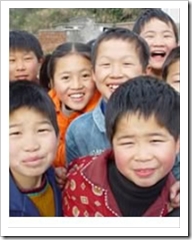
As China becomes increasingly wealthy, the country’s nouveaux riches want to have larger families and are defying their government’s “one couple, one child” family planning policy.
10% of wealthy couples and celebrities are having up to three children each, sparking fears of a population explosion. Officials say that its strict policy has prevented as many as 300 million births, yet it still has a population estimated at 1.3 billion – or 20% of the world total.
And now we are told that couples in richer countries should consider having fewer children as large families are not eco-friendly, according to the Optimum Population Trust. It says that if couples had two children instead of three, they can reduce their family’s carbon dioxide output by the equivalent of 620 return flights a year between London and New York.
I think this is taking environmental concerns too far, equating a child to the number of carbon emissions is ridiculous. It’s ironic that at the same time, some European countries are increasingly concerned about their lower birth rates, the impact this will have on their economic growth, and are offering cash incentives for families to have more children. For example, Sweden provides a mixed package of higher pay for women, flexible working for both parents and high quality childcare.
France provides a series of tax and cash incentives for those having babies. Other countries have also started toying with the idea of straight payments. Poland, where the population has fallen by half a million in the last six years, has recently passed legislation that will see women paid for each child they bear. In Italy, where the population could shrink by as much as one third by 2050, one town has started offering couples 10,000 euros for each newborn baby.
Despite this, the world’s population is expected to increase by 2.5 billion to 9.2 billion by 2050 – with almost all the growth taking pace in developing countries.
Meanwhile, back in China, already destined to be the world’s largest carbon producer, an issue it seems to ignore, many rich families are prepared to pay stiff fines imposed by the government for having a second child, with farmers facing penalties of about 5,000 Yuan (£350) or more than their annual income, to as much as 50,000 Yuan.
I believe that aid agencies should do what they can to provide birth control and educate those in developing countries about unwanted pregnancies. But other than that I don’t know what we can do. How can we deal with population control when each country’s needs vary so much?
It’s always a tricky one this, as it must be considered a “human right” to have a family. In some parts of the world the population pyramid is almost standing on its apex with an ageing populations, while in others they are struggling to feed their children.
I believe the views of Thomas Malthus are still held by some economists and demographers and that the issue will sort itself out when global events (e.g. drought, oil supplies) will militate to produce famine of biblical dimensions. Others predict increasing tensions and border disputes, especially if territory loss is exacerbated by climate change and rising sea levels. But the world cannot sustain exponential human growth for ever, that’s for sure.
Incidentally, did you know you can get your blog “critiqued”? Look here – quite a laugh really!
In this country we should tot up the tax allowance and give both to the single bread winner. Abolish stamp duty and increase the tax threshold . We , the English , are reporoducin at about 1.4 in other words we would theoretically soon all be gone . Its sad that so many women are now missing out on motherhood and one of the things I hate about this government.
I agree Ellee – you can’t value a child in terms of carbon emissions or whatever. Paying people to have children seems to me ridiculous – what about a bit of support for those who don’t, instead? NM, how can you blame the Labour government?
It seems to me that those chinese are only having children because they are rich and they are only rich because we buy their products. the answer is to put tariffs on goods that they make which we can easily make ourselves. This will decrease their economic growth and hopefully decrease their population.
As for our population, we should be reducing it. We are one of the most densely populated countries in the world. The only way to reduce our population is to persuade people to have less children starting by only giving child benefit for the first child. After that if you can’t afford children you shouldn’t be having any.
Isn’t it odd that wealth in the West has resulted in a lower birth rate, whereas in China the opposite is the case.
My point diverges here in that I think it is a mistake to think as a globalist; oh, I know that this is the modern way of thinking but Mr Blair, for example, is such a dangerous blunderer precisely because of this mindset. He believes in the inherent benevolence of mankind and eschews nationalism and border controls “We’re all basically the same …” adhering to the sentiments of John Lennon’s Imagine [Peter Hitchens’ observation]. We’re not all the same – different cultures have different ideals.
It is symptomatic of our misguided sense of empowerment and importance (induced by modern communications)which make us fret about what WE can do in countries like China. We feel more well acquainted with other cultures than we actually are and more inclined to poke our noses into their business.
In actuality little has changed and it will be war and nature – as ever – which manages population levels.
And for those who say “We must do something because we are closer together in such a small world …” I would respond “A small world ? Here’s a bucket of emulsion and a brush – try painting it.”
Very well researched, Lady Ellee and horrifying statistics. The Chinese have much to collectively answer for.
As long as this country is a magnet for all of the EU immigrants to come to, the answer is very clear. People seem afraid to tackle it.
China’s one-child policy has been around for a long time. The population would have started shrinking long ago had not China’s increasing wealth led to greater average life expectancy.
As to the hysteria about over-population, it’s been around for decades and is as nonsensical now as it was then (there’s plenty of room for the few billions of us that there are on this huge planet – see here)
Elliott, I found your post on this very interesting. I wonder how accurate this future population growth assessment can be, how do we know what the future holds with wars – includding possibly nuclear attakcs – as well as famine and flooding, which could increase as a result of climate change. Does nature have a way of sorting these things out?
Quite possibly, but there’s also the possibility that we find a cure for cancer etc. in the same way.
Actually, the UN population data cited by the OPT (shudder!) is based on their “medium cohort” assumptions, i.e. they assume that fertility rates in developing countries fall to the replacement rate over a generation or so (which would mirror historical experience). If you assume that fertility rates stay the same, you end up with a population of 11bn by 2050, so the key to the whole thing is your forecast assumptions. (climate change anyone?) Oh, and the medium cohort also bizarrely assumes that Russia and eastern Europe, which are basically dying out (fertility rates c. 1.3 children per woman) magically revert to replacement over the forecast horizon.
Of course, we could all be wiped out by an asteroid or supervolcano this evening. You just never know. So the best advice I’d give, other than to those (e.g. OPT) whose careers depend on it, is not to worry ..
Elliott, I may not be around in 2050 still, but I do worry about the environment that my sons will continue inherit, and their children, etc. As a mother, I want to know they will be safe and well and not in harms way, but there is no certainty about that – with or without climate change and the world’s population explosion. So yes, let’s live a little. I feel I should pack up the ironing now and do something more fun.
lol Elle, reducing or limiting population growth IS eco-friendly and the surest way of reducing demand for ‘natural’ resources, or increases in waste and emissions.
But hey that is where the first law of self-preservation kicks in. If ‘we’ don’t have more children the world will be overrun by chinese and arabs. And in a ‘democratic’ world where every vote counts – is it any surprise the EU doesn’t want 80 million Turk votes altering the ‘democracy’
Ironically Malthusian theory was dicredited – Nature has shown it can feed the population explosion in Africa, China & India
History has shown Darwinism to be true – those who do not pro-create are set for extinction.
Recreation without procreation may be fun, and too much procreation may leave no room or time for recreation. But some out there (and over here) are determined to populate and ‘own’ the world – at all costs.
Elle, No sex please, we’re British!
wayne
this is neanderthal drivel.
Australia has a policy of paying parents to have children and recommends each family now has 3 each.
The reason is to find taxpayers to keep the retirees from starving to death.
The problem i have with this ridiculous article is twofold;
i) if one child really is the equivalent of 620 flights, then what is the point of my cancelling my holiday to spain for the sake of the environment? the difference it will make is zero.
ii) by refusing to say that pop growth must be curtailed in developing countries, the author reveals himsef to be nothing more than old-fashioned self-loathing Luddite.
utter nonsense which shd be immediately consigned to the bin (and recyled of course)
The first thing you will have to do is prove that a population growth is bad.
Of course it’s bad if the country can’t support it, but no one wants the poor countries to stop having children.
The second thing is to prove that ‘lowering’ your carbon-footprint is actually good for the world. Since the Sun isn’t going away, I’d say we could trim the population by a billion or so and cancel all the SUV’s and we’d still have Climate Porn on all the news.
Here is my blog on this very topic and how it relates to Canada, which is overpopulated given its climate and geography.
We are losing biodiversity fast. Mass immigration (highest per capita in the G8) is trashing our Canadian landscapes, accounting for 2/3 of Canada’s population growth. Baby bonus programs and child tax benefits are fueling net reproduction. Canada is experiencing the most rapid loss of natural capital in the world. Our forests are being clearcut and strip mined, our oceans overfished, our lakes, rivers and soil polluted.
There is no such thing as environmental protection alongside population growth.
http://ecologicalcrash.blogspot.com
Here’s a similar blog:
http://sinkinglifeboat.blogspot.com
Here’s the online archive of our mailing list:
http://lists.topica.com/lists/sinkinglifeboat/read
pommegranate, If you read the text again, you will see that I do not support equating children to carbon emissions, it’s a terrible idea, I was merely telling you this has been suggested by others. I also thought it was interesting how different countries were tackling their population growths – or lack of it in parts of Europe.
Brishen Hoff, thanks for the links,I will check them out.
This is an interesting and intelligent post about a subject I’m interested in, but allow me one moment of frivolity – we could neuter all the men currently of age on the planet, thus taking out a couple of generations of births. Oh hang on, didn’t Hitler have a similar idea on a smaller scale?
Sorry about that but I find that when seeking answers to population control they often stray towards practices that shouldn’t happen or are uncomfortable when we also herald freedom of choice. I can see money/fines as the only pressure governments can impose. Either that or natural selection in the form of poverty and disease. I would advocate contraception but you can’t force it on people. If you look at pictures of starving Africans who’ve been living in a famine for 4 years, they always feature an emaciated baby at a womans breast. What the hell is she doing getting pregnant in those conditions? The answer might be that when you are lying around half starved, you find comfort in anothers arms, or at least something to do. So the brutal answer to population control could be.. don’t feed them, let ’em die. As Steve Irwin says, it’s natures way. When we interfere with welfare and medicine (and I’m not saying we shouldn’t) this is the problem we encourage, in our own country as well as others.
But why should one country pay for births when another is producing merrily. Instead of the Poles comming here, we could all emigrate there! Perhaps there are natural fluctuations across the globe and governments should just butt out? I’m not sure I’d go along with that but I do wonder if nature would even things out in the end.
Mussolini, of course, tried to increase the Italian population with financial incentives.
You can’t change human nature and you can’t impose your doctination on others indefinately. You can educate – yes; but impose – no.
Sadly, anyone acquinted with Malthus will real;ise birth control can never be the only answer
we need more space for our species as a whole. That’s fact.
Maybe a bit more effort and resources being used in projects that actually benefit the human race long term would not go amiss.
not just cheap probes that get lost. (Sorry, Dr Pillinger, no offence meant.)
I think joe has a point as I have a list of people I could happily see banished to Mars.
Human hating is another fabulous exposition of the Leftisit world view.
Elle
my comment wasnt directed at you.