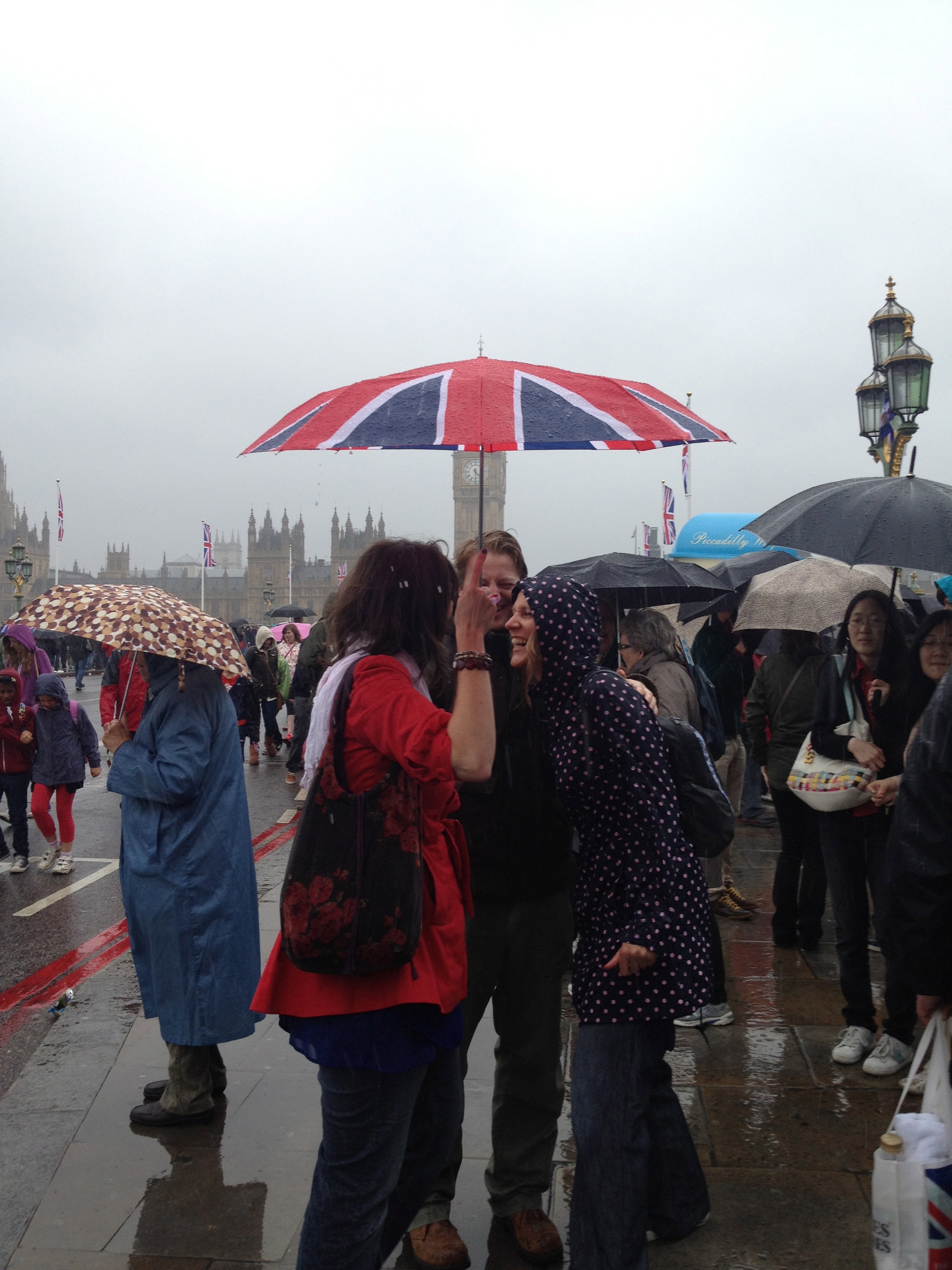
It was an astonishing jubilee weekend, marred only by the unexpected poor health of Prince Philip. One wonders, with hindsight, how an elderly couple could have been expected to stand for four hours, especially during the wind and rain; us lesser mortals would certainly have found it too much.
I was fortunate to be by the river for the pageant – second row from the front after taking our place just after 10am. The front row went to seasoned royal revellers who arrived from 7 am with their fold-up seats, fishing brollies and their camping gear, and surely deserved their prime location for such devotion. It was wonderful to see so many smiling faces walk by, hundreds and thousands of excited supporters who wanted to witness this historic moment, the Queen’s Diamond Jubilee celebrations.
The atmosphere was tremendous as the crowds whooped and cheered, loving the musical boats, but then scattering as the downpour suddenly began and the heavens opened. Nobody seemed to mind too much – after all, it was expected, albeit earlier in the day. The main frustration was trying to get across bridges which were closed, and having to unnecessarily detour while we were soaking wet in search of warmth and shelter.
The icing on the cake was going to the concert at the palace last night, watching it on one of the screens from one of the many nearby vantage points. What a sensational jubilee weekend, and the chances are we will never live through such an historic occasion again.
To remind us of the momentous changes over the last two generations from when the second Elizabethan age began, these are some other events which happened in 1952:
- 1 February – The first TV detector vanis commissioned in Britain, as the beginning of a clampdown on the estimated 150,000 British households which have unlicenced television sets.
- 26 February – Prime Minister Winston Churchill announces that the United Kingdom has an atomic bomb.
- 1 June – A one shilling charge is introduced for prescription drugs dispensed under the National Health Service.
- 19 September – English film star Charlie Chaplin, sailing to Britain with his family for the premiere of his film Limelight (London, 16 October), is told that he will be refused re-entry to the United States until he has been investigated by the Immigration Service. He chooses to remain in Europe.
- 29 September – The Manchester Guardian prints news, rather than advertisements, on its front page for the first time.
- 3 October – Operation Hurricane: the UK explodes its first atomic bomb in the Monte Bello Islands, Australia.
- 5 October – Tea rationing ends, after thirteen years, as announced by the government two days earlier.
- 4–9 December – Great Smog blankets London, causing transport chaos and, it is believed, around 4,000 deaths.
- 12 December – BBC children’s television series Flower Pot Men debut.
Wishing Prince Philip well in what sounds like an extraordinary event, Ellee.
It was an astonishing jubilee weekend, marred only by the unexpected poor health of Prince Philip.
Plus them being made to stay out there for hours plus the BBC coverage, Ellee.
I couldn’t believe news reports of the dire BBC coverage and inaccuracies.
Here’s an amusing tale. A couple from Ely booked into a hotel at the weekend near the river and on the morning of the pageant, they looked outside and saw the well wishers were only one deep. They decided to go back to the hotel, spend the morning there and then return outside after lunch for their riverside view. Only by the time they had had their lunch, the crowds were then 10 deep, and they couldn’t see a thing. So they jumped into a taxi and headed back to Ely and saw the end of the pageant on their TV. BBC no doubt!
You couldn’t make it up!
it was a superb celebration never saw any celebration like this before