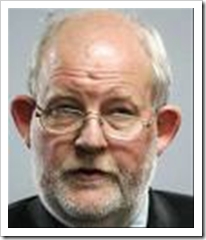
What an amazing coincidence. The very same evening that Guido accuses  political hacks of being restrained, Charles Clarke blames the mainstream media for creating “a lack of national self-confidence” about Britain – and suggests that legislation might be necessary for them to toe the line.
Strong stuff. And ironically, the sacked Home Secretary vented his anger against the media in a speech at the Royal Television Society entitled “New Labour & The Media: Ten Years On”.
He urged politicians not to pander to the Press, described how the media had been setting the political agenda and that Labour should “reinvent” itself if it wanted to win the next election.
Here are a few of his quotes:
“The media does need to restrain itself, and if it does not do so voluntarily then it will need to be done by statute. Of course many parts of the media do not accept the need for some of these constraints but I hope that our media will accept that they and the way in which they report does have an important influence upon our society, and that means that they have to make some changes to the way in which they look at the world.”
And …
“We have to be absolutely clear that the decisions we take in Parliament or Government are principally motivated by the merits of the case and not by the search for media plaudits, Party applause or personal advantage.”
And ….
“The last ten years have been a decade of media pomp, in which the new Labour Government has too often colluded. The practices which I think were necessary as we came to power have been extended and developed in ways which have ultimately damaged the political process and trust in politics and politicians, particularly from New Labour.
“..media power has changed Government policy on important matters of substance. I have no doubt that media attitudes and threats have been decisive in influencing British attitudes to the European Union, in inhibiting reform in the criminal justice system, in influencing levels and structures of taxation and of course in influencing policies towards the media itself. In general this media power has focused upon short-term quick fixes, sometimes purely presentational, rather than the kind of long-term and difficult reform which many of our institutions need, in some cases desperately.”
And…
“I have to say that Labour’s greatest need, if we are to win the next General Election, is to assess openly and genuinely our successes and failures in government. I am certain that on that basis we will need to reinvent ourselves. We cannot and should not say to the British people that a vote for Labour is simply a vote for more of the same. And there is no way to do that without talking about the issues, openly and confidently, as I have been trying to do for some months now.
“And it is certainly right that there are serious divisions caused by those candidates for Leader and Deputy Leader who have entered the contest before there’s even a vacancy, who have publicly appointed their campaign managers and who prefer backroom conspiracy and plots to open discussion of the policy challenges we face.
“These actions weaken the Party in any case. But they also undermine and weaken the authority of the Prime Minister when authority is important, as we see in relation to Iran today. These matters have to be dealt with and solved by a strong Prime Minister, with the support of the whole country.”
And…
“We need to talk straight to people, engaging the concerns and questions that they have, rather than appearing to evade and dissimulate.
“These things are particularly important for Labour, since in the eyes of the people, as shown in poll after poll, trust in the New Labour leadership of Tony Blair, Gordon Brown and John Prescott has evaporated, wholly unjust though that is.”
And …
“..perhaps most damaging of all is the way in which some parts of the media have built up or reinforced a mood of lack of national self confidence. “
Charles Clarke goes on to say that people are better educated and more questioning, so why can’t they be allowed to make their own mind up about what they read or hear via the media? Why should Labour need to reinvent itself if it feels it has done a good job? Interestingly Charles Clarke describes how Tony Blair wooed the Press in the early days of New Labour, but that it has now turned sour for them.
Following on from the proposed recent restraints to the Freedom of Information Act, it is ludicrous to imagine that our Press will agree to any further restrictions. Our free Press must be maintained, it’s an inherent part of our democracy. It does not pander to the spin of government any longer, but reflects the mood of today’s society, else it cannot succeed.
The full text of Charles Clarke’s speech can be found courtesy of Nick Robinson, scroll down to the end of the post.
A frightening and yet entirely predictable development which must be resisted. The media has simply taken up the mantle of the failed Conservative opposition.
If the authorities could keep our streets clean and the yobs under control I would not be here, Ellee. But they aren’t even capable of this: we get the worst of the leftist ideology (thought control) and the worst of the capitalist (social anarchy). The media aren’t stirring things up, they’re keeping a lid on the situation – these buffoons are just too stupid and arrogant to realise it.
I do believe there are some cases in which the media attempt to write the agenda, and not just in politics. Witness the hounding of sports managers, for example.
I’ve read the full text of the speech and have to say I think it’s a good and well-reasoned one. CC does give an example of the kind of behaviour that he is talking about – the tapping of Royal Family phones by the News of the World. And the media do stir things up – OK, that is part of their job. But remember that poor woman paediatrician in Newport who had to flee because the papers had whipped up such a fever about paedophilia that the “mob” didn’t even consider what her job title meant! Having said that, the fact that we have an enquiring and cantankerous press is one of the better things about Britain and I recently talked to an Italian who was [positively] amazed that Paxman and others will keep on at a politician until they get an answer.
The media can set an agenda – as can government, business and most others with the skills and power to get attention for their message. Journalists do also have responsibilities – although there will be debate about these as one person’s freedom of speech is another’s propaganda and another’s trigger for censorship.
A more educated public should be able to consider variety of arguments in which case the media do not simplistically tell us what to think. Although even those with time and inclination to check information find it hard to do. So public opinion will be formed from a variety of single-sided perspectives.
And yes, politicians – and football managers as Jim alludes – do get a tough time from the media. But like celebrities, they lap it up when it is in their favour and want to take their ball home when it doesn’t. Controlling the media to say what you want may make those in the news feel better – but isn’t that a common practice in countries whose ethical behaviour we deplore?
Silencing the press is another step towards authoritarianism,the fourth estate needs to be more agressive in holding the politicians to account not less. Unfortunately the Press has chosen to include frothy ‘celebrity’ stories that are of no account in their remit.
Charles Clark is a bag of Old(ish) labour crap and the only reason he does not like the media is that the media is sensing the tide is turning against him and his vile, brigade of statist despot parasites. The NS is predicting that there will a Charles Clark assault on the Deputy Leadership and he is exactly they need .The illusion of resistance so the Party can have some fake healing process without the slightest chance of any disruption to `Da Broon succession . Clark has been touring up and down the country campaigning and as Miiliband is only fishing for position , like the lickle spit invertebrate weasel gob he is , Clark may well get the “ Show Trial gig�. He is a hired gun chasing down the outriders a technique the filthy sordid Blair lie machine have perfected over ten years. This is all about Brown as is everything he has said been for months
AS we all now know Martin Bright , once a find journo has sold out to the Brown Nose tendency and the fact he is supporting the Clarke Deputy Leadership tells you all you need to know about it .Here he is trying to apologise to the Country for the mockery that New Labour have made of the political process and the reams of Press driven legislation( Dangerous Dogs …is that the nadir?) in his government . The rumour is that he may be back on the cabinet as the acceptable face of Blairism to the Old Labour faction who are even now licking their lips at the possibility of “wealth Redistribution� ie state theft with menaces on a massive scale
Charles Clarke call the coalition for whom Labour speak “ the Old Labour Activists and the Middle England Public Sector Professionals) …ie no-one who makes any money . What sort of man can live with the knowledge of his own mendicant status ?
I am sick sick sick of this Soviet style lying coming form the squawking socialist fellow travellers. As working men’s clubs are shut down they are out campaigning against the smoking ban on clubs in their own seats . They know this is an essential component of their own illiberal legislation, same with closing hospitals and now the Labour Party is complaining about press driven Government !!! The first thing to do is to say I am not taking it any more .
Damn them !! Damn then all to hell !!
oops that should be
” Damn them all to hell!”
ahem
Given that the Conservative Party has been unable to hold the Government to account for ten years now, the role has naturally fallen upon the media. Nothing that David Cameron offers the electorate will change this and condemns 40% of the electorate (including me!) to have no voice at election time.
The lack of English self-confidence is entirely due to ten years of New Labour and their hatred of all things English.
I liked the quotation, “The practices which I think were necessary as we came to power have been extended and developed…….”
In other words, it was OK for us to use the media to our own ends, but it’s now necessary to legislate to stop anyone else doing what we did.
You have to admire the cheek of this awful old socialist, and be grateful that his uselessness is appreciated by his enemies in both the Blairite and the Brown camps, so hopefully he won’t get to practice what he preaches in the future.
This is the man who urged the closure of medieval history departmnts at Universities.
As someone who specialised in Medieval epic and romance literature, I wasn’t impressed.
So little so I was thinking of volunteering my services to the Norwich South Lib Dems for the next election.
Hey Joe, I didn’t know about your Medieval background, that’s really interesting.
You’re not serious about volunterring for the Norwich South Lib Dems, btw, are you?
“The basis of our governments being the opinion of the people, the very first object should be to keep that right; and were it left to me to decide whether we should have a government without newspapers or newspapers without a government, I should not hesitate a moment to prefer the latter. But I should mean that every man should receive those papers and be capable of reading them.” –Thomas Jefferson to Edward Carrington.
I assume Jefferson would also have been in favor of blogging….
I’ve re-read the quotes again and I am still astonished. Nothing has been more damaging for the publics’ trust in government than the way in which Nu Lab have used media spin, leaks and smears and yet the onus is on the press – no doubt of the right wing – to “…make changes in the way they look at the world” Frightening stuff, and curiously comic beyond parody at the same time.
It appears we must be ‘educated’ in the benefits of Nu Labour. No doubt on the European Union we must be ‘educated’ too – I am sure that one day our children will learn to love it.
I would also like to point out that newspaper sales and influence are not entirely undemocratic; people generally choose the paper that reflects their core belief and few of us choose a paper that reports the news impartially. And even if such a journal exists none of us are educated enough to analyse every subject without the influence of expert journalisitic opinion. Moderate language does not necessarily make for moderate politics, absence of topic can be as manipulative as sensationalism and some of the most important expos’es have originated from the ‘howling’ tabloids.
In fact our allegience (freely given) to newspapers is sometimes like party membership. In the absence of a party suited to me I have relied on a particular journal (and journalist) to speak for me – I have had many exchanges with both including frequent disagreement, so who influences who ? And whose fault is it that newspapers have become so powerful ?
BTW am I taking Charles Clarke too seriously ?
I feel very strongly that the sooner such a philistine is removed from the vicinity of any arts funding the better.
If that means wearing a yellow rosette, I’ll do it.
Yes Ellee, I specialised in Mort d’Arthur, The Faerie Queene etc. As an effete aesthete, I would hate to see such treasures forgotten.
Kevin, the whole speech is truly astonishing, and even naive in that Labour created the present media power, the sucking up to them that has become established. I really recommend you read the whole speech.
Joe, That’s a very specialised area, maybe you would like a guest post here to tell us all about it.
Ejecting Clarke or the Arthurian legend?
It’s a while since I read them, but I must have in my possession most of the key Arthurian text. I find the growh of the myth a fascinating phenomenon, especially in it’s cultural/allegorical tapping in of the changing British psyche throughout history. Compre how the legend changes to fit new audiences.
All mythologies do the same of course.
Joe, I think we could have a good philosphical debate on this subject, you are welcome to have a guest post here to tap into our psyche if you wish and compare legend changes to new audiences.
Well, I’m no expert, I was hardly the most studious of students, this was just what I specialised my degree in, and I was quite in to it- as opposed to all those dreary nineteenth century novels we had to do.
And Sterne- God!
But I probably would count Arthurian Literture, The world of JRR Tolkien, Psephology and Irish History as my specialist subjects, if I had any.
But certainly it’s interesting to compare the sades of Henry ii Arthur of Geoffrey of Monmouth to the Raleigh like prince of Faerie Queene…